

“Maybe there is something that comes from even deeper, an affinity of a certain culture and mentality, that comes from maybe centuries ago.” – Harry Gruyaert
Newly published by Thames & Hudson, “Homeland” by Magnum photographer Harry Gruyaert is a compelling, cinematic portrait of his native Belgium.
A hugely influential figure in contemporary color photography, Harry Gruyaert was born in Antwerp in 1941. He initially studied photography and filmmaking, beginning his career as a director of photography for Flemish films before relocating to Paris in the 1960s and began photographing life on the street. Over the ensuing decades, he traveled the globe, forging a reputation as one of the most pioneering color photographers of his generation, known for his captivating depictions of everyday life worldwide.

Drawn to the neon energy of the United States and the vibrant palettes of India, Egypt, and Morocco—where he produced some of his most compelling work—Gruyaert returned to his homeland routinely, but rarely viewed it with the same artistic interest as those more “exotic” locations. To his younger eye, Belgium was a land of oppressive grayness and strict Catholic tradition; merely a place to escape, rather than to immortalize.


The book’s structure reflects this early detachment. It opens with a series of stark black-and-white images, a monochromatic immersion into the “gray” Belgium Gruyaert once sought to flee. As Brice Matthieussent notes in the book’s introduction, Gruyaert’s early photography of religious processions was almost a form of “revenge” against a rigid upbringing. A dramatic contrast with the color-rich imagery for which he is renowned, these monochrome photographs serve as a vital historical anchor, showing the starting point of a photographer who once claimed he shot in black and white simply because he “didn’t see any color” in his surroundings.

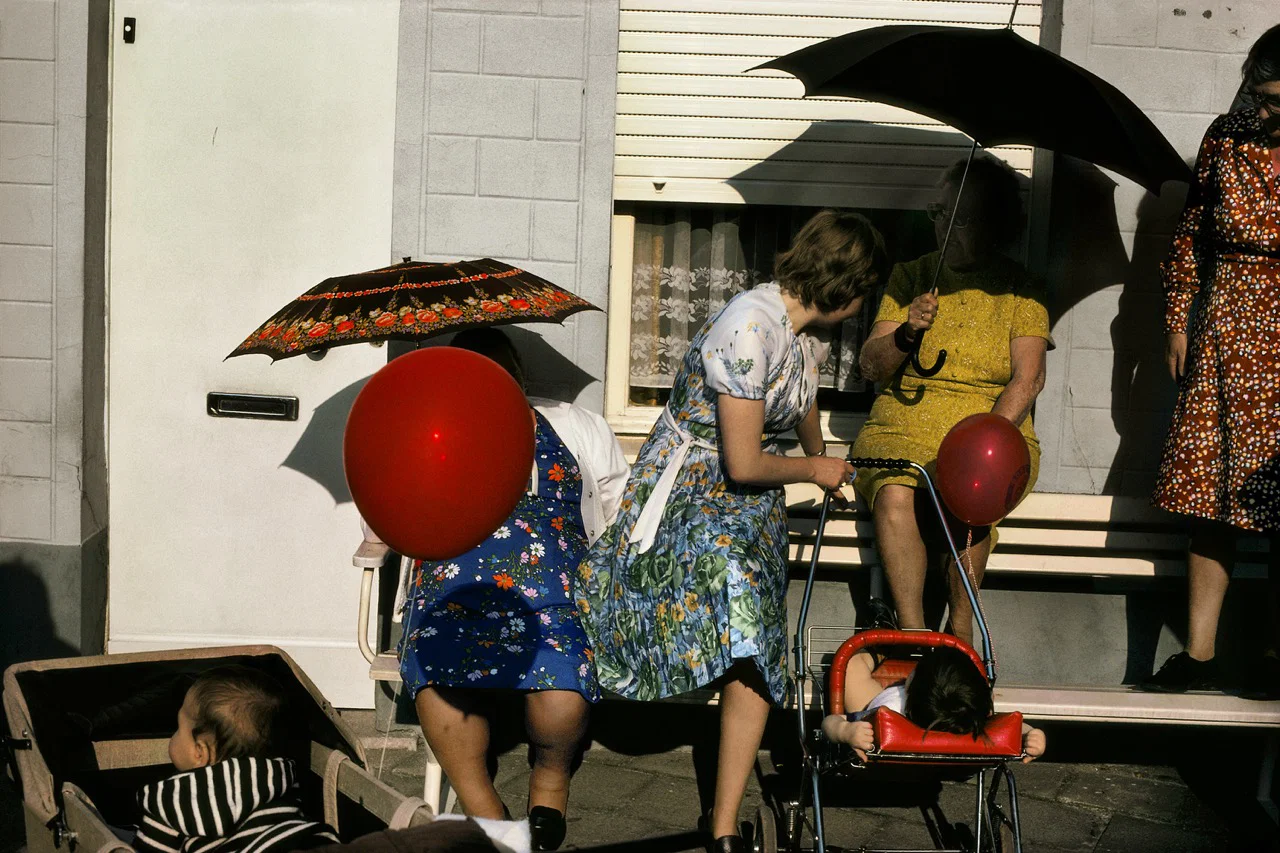
Yet, gradually, as he returned from the far-flung locations that served his eye for color so well, he began to discover “the beauty of banality” in the mundane scenes of his birthland. Heavily influenced by Pop Art and the Flemish painting tradition, Gruyaert began to treat color as a structural tool, using it to “sculpt” the world. Whether it is the candy-colored allure of a carnival in Antwerp or the lonely, Hopperesque glow of a storefront in Liège, these scenes are intensified with densely packed hues that transform everyday life into surreal, cinematic compositions permeated with a sense of tension.


The images demonstrate the masterful use of light and shadow for which Gruyaert is renowned: the way a single neon sign cuts through the dusk, or how the sun catches the plastic sheen of a pink tarp draped over a pile of pallets. His compositions often feel like a meticulously blocked film scene, where every element, from a stray dog to a distant chimney stack, contributes to a quiet, brewing narrative.

There is a distinct irony in the fact that this collection perhaps best encapsulates Gruyaert’s philosophy. Where he was an outsider in Morocco or India, the moments of quotidian life were naturally more striking to his foreign eye; but here, in the quietude of Flanders, his ability to transform the mundane into cinematic tableaux is truly laid bare. Through distance and time, he found something new in a place so familiar, bringing to mind the adage that the real voyage of discovery consists not in seeking new landscapes, but in having new eyes.
All Images © Harry Gruyaert / Magnum Photos
Homeland is published by Thames & Hudson and is available here.