

“I see wondrous things!” — Todd Webb
Few photographers have lived as many lives as Todd Webb. Stockbroker. Gold prospector. Forest ranger. Naval photographer. Expat in Paris. A man who crossed America on foot with a large-format camera. And yet, for all that movement, his photographs are marked by stillness, by a patient, frontal clarity that reveals the extraordinary within the ordinary.
Born Charles Clayton Webb III in Detroit in 1905, Webb came of age during the feverish optimism of the 1920s, working as a successful stockbroker before losing everything in the Crash of 1929.
What followed was not reinvention so much as wandering: years spent prospecting for gold, working in the forests of the American West, and attempting to write fiction that would never find a publisher. It was during this unsettled decade that he first picked up a camera. Photography, unlike writing, offered immediacy, a way of traveling, meeting people, and quietly recording their presence.

In 1938, Webb joined the Chrysler Camera Club in Detroit, where he met Harry Callahan, then an emerging photographer who would later become one of the most influential teachers in American photography.
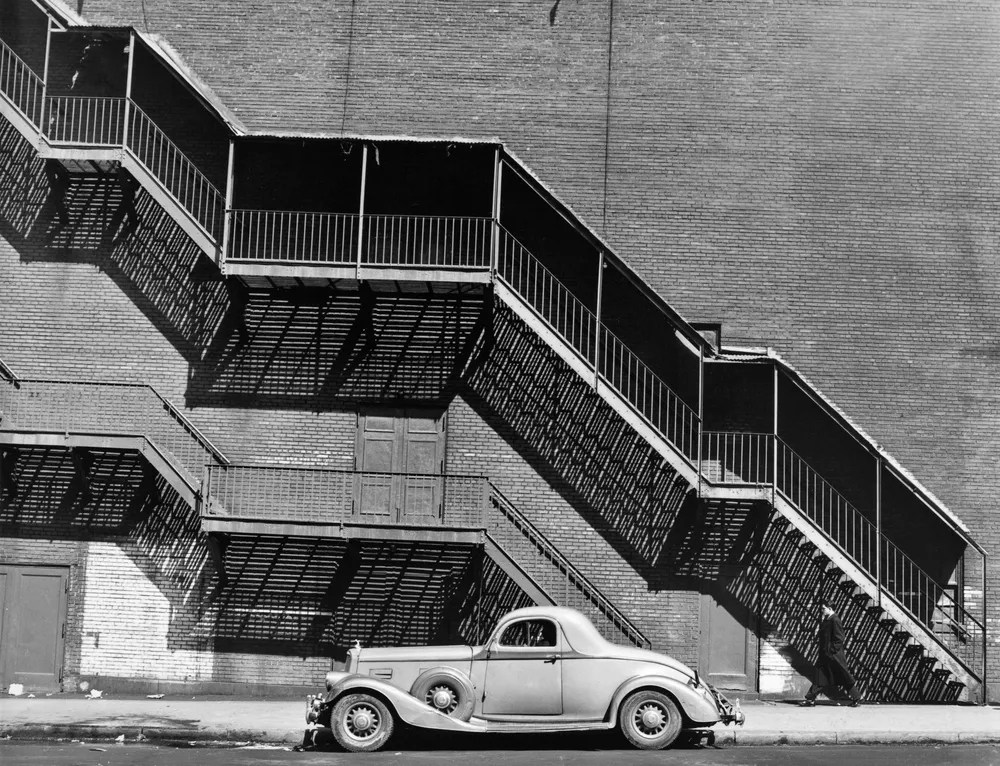
A workshop with Ansel Adams confirmed Webb’s commitment to “straight photography”: sharp focus, careful composition, fidelity to the visible world. The discipline suited him. Webb was drawn to structure, to the geometry of buildings, to the way figures occupy space, to the quiet choreography of daily life.


After serving in World War II as a Navy photographer, Webb moved to New York in 1945 with a singular intention: to photograph the city. Armed with a large-format camera and tripod, he set about constructing one of the most lucid portraits of post-war Manhattan. From Midtown skyscrapers to Lower East Side tenements, from businessmen to street vendors, Webb worked slowly and methodically, positioning his camera at street level and allowing the architecture to anchor the frame.

Though often described as “the most famous photographer you’ve never heard of,” Webb moved within remarkable circles. He formed a close friendship with Alfred Stieglitz, whose wife, Georgia O’Keeffe, became another confidante. Through them, Webb met curator Beaumont Newhall, who organized the first major exhibition of his work at the Museum of the City of New York. He also worked under Roy Stryker, contributing to documentary projects that demanded precision and narrative clarity.


Yet Webb’s New York photographs resist drama. There is no theatrical chiaroscuro, no decisive moment in the Cartier-Bressonian sense. Instead, his images are balanced and frontal, attentive to repetition and proportion.
People appear integrated into their environments, neither romanticized nor diminished. At first glance, they seem almost plain. Look longer, and their complexity unfolds, subtle tensions between subject and setting, between permanence and transience. Crucially, this precision is never cold; there is an inherent warmth in his gaze, a quiet affection for the texture of a brick wall or the posture of a neighbor that prevents the work from feeling like mere clinical documentation.

In 1949, Webb moved to Paris, where he met his wife Lucille and remained for four years. There, the influence of Eugène Atget becomes visible. Having studied Atget’s prints in the collection of Berenice Abbott back in New York, Webb applied the Frenchman’s “straight” documentary style to the streets of Paris.
Like Atget, Webb found poetry in shopfronts, courtyards, and quiet streets. But while Atget sought to preserve a vanishing past, Webb was less nostalgic; he was attentive to the present moment, to a Europe reshaped by war and reconstruction. Commissioned to document the impact of the Marshall Plan, he photographed a city suspended between memory and modernity.


Awarded successive John Simon Guggenheim Fellowships in 1955 and 1956, Webb traced the pioneer routes westward, following the paths settlers once took toward Oregon and California. His contemporary, Robert Frank, was awarded a fellowship in that same year, using it to produce his restless, gritty masterpiece The Americans. But where Frank drove, chasing fracture and velocity, Webb walked. The distinction is telling. Webb moved at the pace of the body, not the automobile; his America is measured and spacious, attentive to continuity rather than rupture.

In 1958, this same patient gaze was turned toward a continent in transition. Commissioned by the United Nations to document ‘industrial progress’ in Africa, Webb traveled through nine countries—including Ghana, Sudan, and Togo—at the dawn of their independence. While the UN sought propaganda to highlight modernization, Webb returned with a vivid color archive that went far beyond his mandate. Rather than focusing solely on steel and steam, he captured the vibrancy of the streets and the quiet dignity of a people reclaiming their sovereignty.


For over fifty years, this body of work remained a ghost in his biography. The UN had used only a handful of black-and-white crops for a small brochure, and the original negatives were eventually lost. It wasn’t until 2017 that the work was finally rediscovered by Betsy Evans Hunt, the director of the Todd Webb Archive and a close confidante who had become like a daughter to the photographer in his later years.

While tracking down Webb’s missing materials in California, she located five steamer trunks that had been separated from his main collection for decades. Inside were over 2,000 Kodachrome slides, a breathtaking “lost” archive that revealed Webb as an early master of color documentary, long before it gained widespread acceptance. This discovery stands as a vivid record of a region in the midst of a shifting political landscape, and proves that Webb’s eye for structure and human connection was as potent in these bustling markets as it was on the sidewalks of Manhattan.

Across decades, Webb built a body of work that has secured its place in American photographic history. Since his death in 2000 at the age of ninety-four, Betsy Evans Hunt has directed his Archive in Maine, meticulously managing his estate and ensuring his work secured a permanent place in galleries and major institutions worldwide. His work is now held in the permanent collections of the Museum of Modern Art, the Metropolitan Museum of Art, and the J. Paul Getty Museum, among others.

Webb’s life, like his photographs, resists easy summary. On the surface, they appear simple: buildings, streets, figures in space. But beneath that clarity lies something quietly profound, an insistence on attention, on steadiness, and on the belief that the everyday deserves to be rendered with care.
In an era increasingly drawn to spectacle, his work reminds us that the camera need not shout to be heard. Sometimes it is enough to stand still, to look directly, and to let the world reveal its own complexity.
All Images © Todd Webb Archive / MUUS Collection