

“Honey Hunters”, by Andrew Newey, documents the Gurung people of central Nepal and a centuries-old practice passed down through generations.
For centuries, the Gurung have risked their lives harvesting honey from sheer cliffs in the foothills of the Himalayas. Suspended hundreds of feet above the ground on handmade rope ladders, honey hunters carefully collect the nests of Apis laboriosa, the world’s largest honey bee, using techniques that have remained unchanged for centuries.

The tradition is deeply embedded in Gurung culture, combining practical skill with spiritual ritual. Before each hunt, offerings are made to the cliff gods in a ceremony intended to ensure a safe harvest. Yet today, this centuries-old practice faces mounting challenges. Commercial demand for Himalayan honey, the rise of staged “honey tourism,” changing environmental conditions, and a lack of interest among younger generations all threaten its future.


In 2013, England-born documentary photographer Andrew Newey spent two weeks living with a Gurung community in Nepal’s remote Kaski district, documenting one of the region’s traditional autumn honey hunts. His goal was to record both the extraordinary risks involved and also a way of life that is becoming increasingly difficult to preserve.
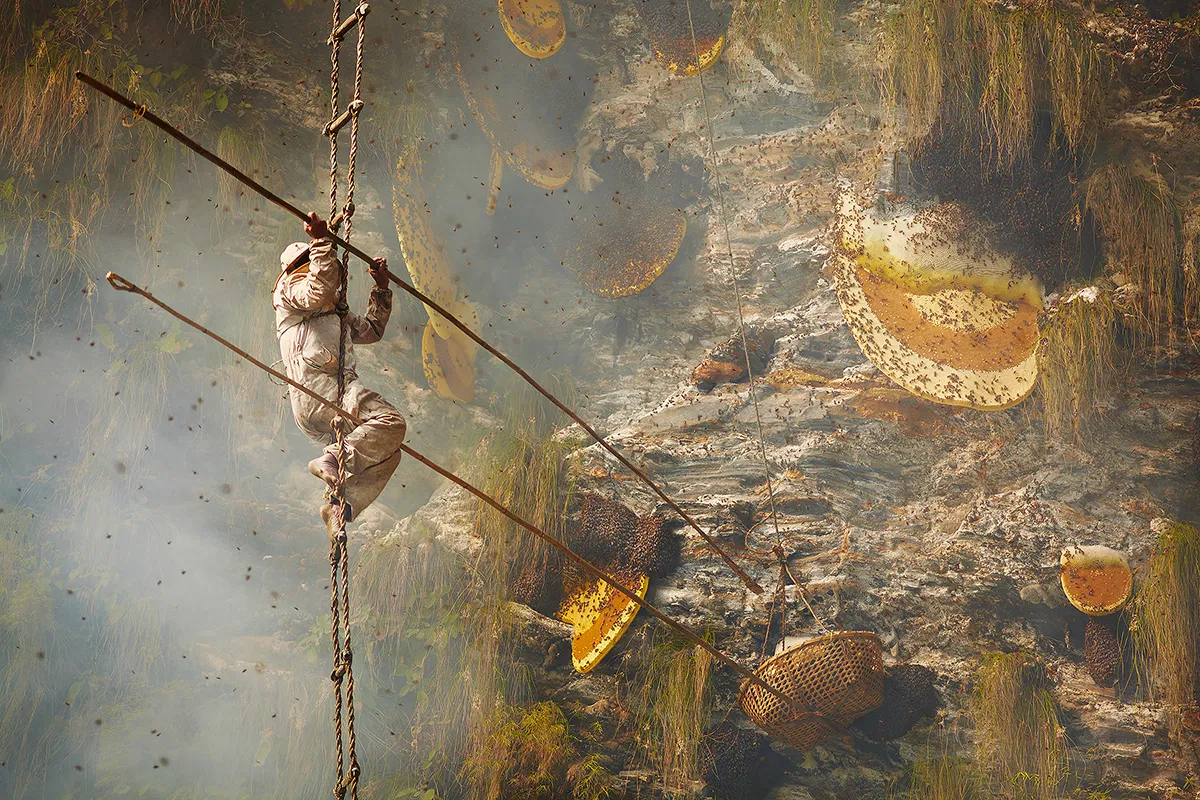
At once dramatic and intimate, Newey’s images place the viewer at the heart of the hunt. Small figures hang suspended against immense rock faces, engulfed by smoke and swarming bees, conveying both the danger and skill involved in the harvest. Yet the project is equally attentive to the lives that exist beyond the cliffs. Portraits and quieter observations ground the story in the community itself, creating a nuanced record of a tradition that has endured for centuries but now faces an uncertain future.

Newey’s desire to document the Gurung was sparked by Éric Valli and Diane Summers’ iconic 1987 National Geographic documentary, The Honey Hunters. Decades later, hearing about the environmental damage left behind by mass “honey tourism” convinced him it was time to shoot a photographic follow-up.


Getting the project off the ground, however, required immense patience. Because traditional honey hunters now hide their locations from commercial exploits, Newey quickly realized that, as he put it, “the good guys were in hiding.” To build a bridge, he spent two weeks simply living alongside the villagers before the harvest even started, an experience he calls “time very well spent helping gain the trust of the elders.”

When the hunt finally began, capturing the close-up grit of the harvest meant managing extreme physical risks. To photograph the men engulfed in thick smoke and swarming bees, Newey relied on a telephoto lens from a safer vantage point. Bringing in modern climbing gear wasn’t an option, as it would damage the cliff face and disturb the bees, and the traditional handmade rope ladders proved unpredictable. “I did attempt to climb the rope ladder,” Newey recalls, “however, the third rung snapped. Luckily, it was only the third and not the forty or fifty-third!”
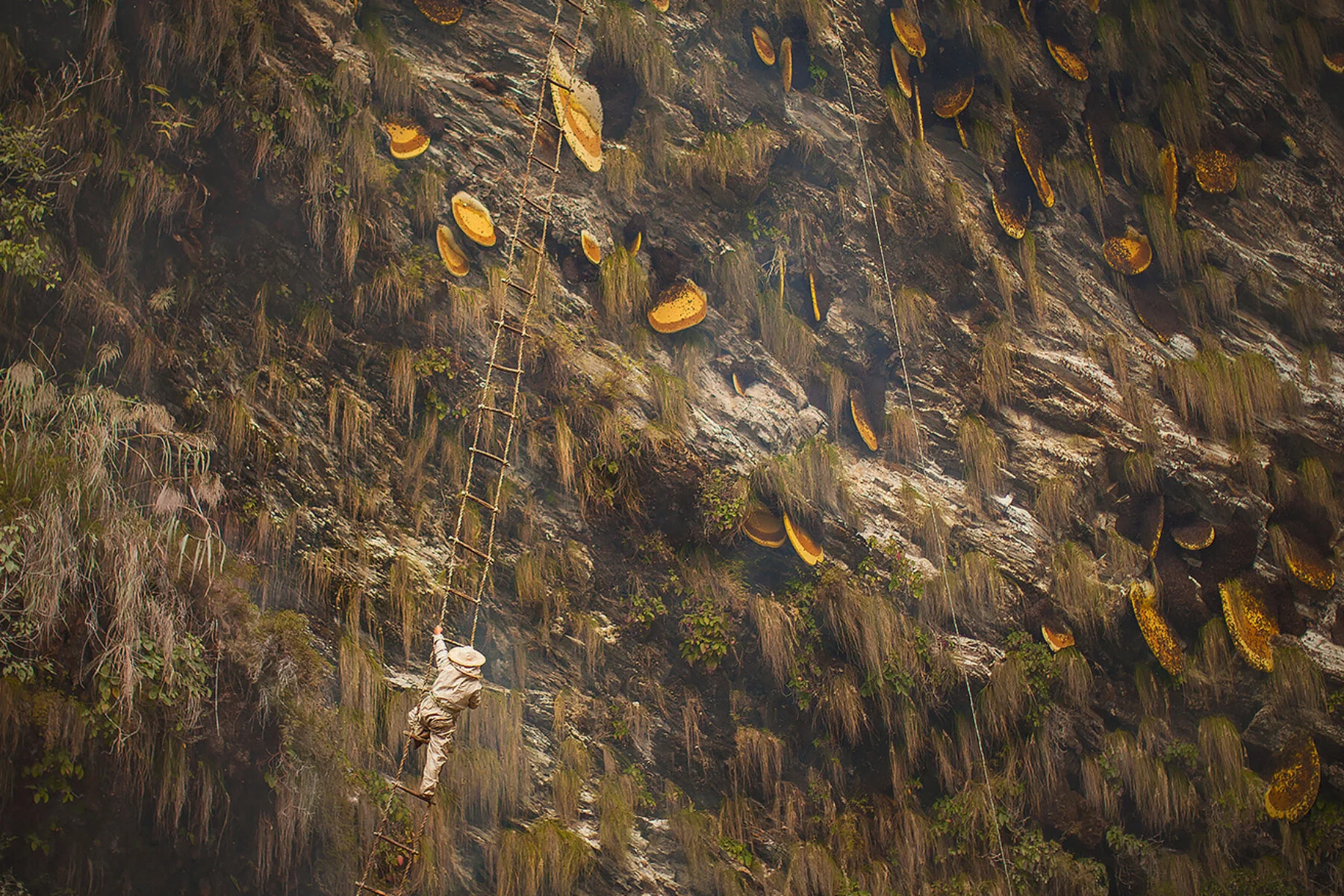
Beyond the physical peril, Newey’s time in the village illuminated the stark ecological and economic pressures reshaping the region. The autumn hunt he documented had already been delayed by an unprecedented six weeks due to shifting weather patterns. This climate instability directly impacted the harvest itself; the community watched their yield plummet from the previous year’s 200 litres to a mere 80 litres during Newey’s stay.


While conservation bodies like the International Centre for Integrated Mountain Development (ICIMOD) have attempted to step in with protective regulations and licensing systems to safeguard Apis laboriosa, enforcing them remains a near-impossible task. Because the nesting sites are so profoundly isolated, Newey learned from local contacts that authorities face immense difficulties tracking compliance across such remote and intentionally secret locations.

Ultimately, however, like many long-standing traditions, the greatest threat to its survival is a lack of interest from younger generations. While the small children in the village that Newey spoke to still look up to the hunters, the majority of the teenagers and young adults are choosing a different path. Facing life-threatening risks for dwindling returns, they are “simply not prepared to risk their lives for such little reward,” opting instead to move to nearby towns and cities for work. Thus, Newey’s images capture more than just a remarkable tradition, but a way of life that may soon disappear entirely.
All images © Andrew Newey