

“It is in New York that the world’s voice can most clearly be heard.” — James Baldwin
Perhaps no city has produced such a wealth of iconic imagery as New York. A place of relentless energy and constant reinvention, it has long captivated photographers, its skyline, streets, and people embodying the drama, dynamism, and diversity of modern life. For a century, they have been drawn to its towering architecture and teeming sidewalks, finding poetry in its chaos and beauty in its grit, capturing images that together form an ever-evolving portrait of the city that never sleeps.
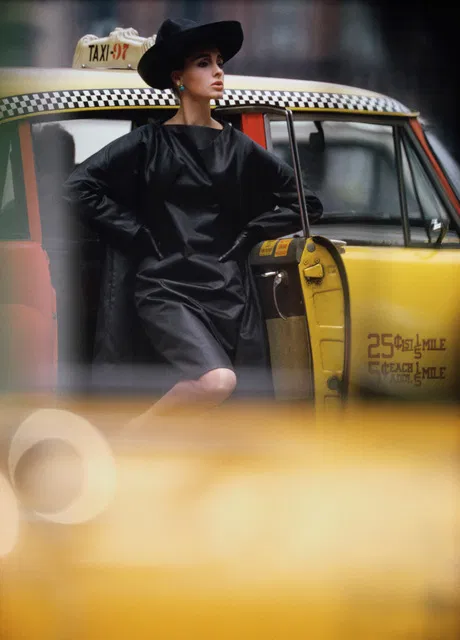
1. Antonia + Taxi, New York (Vogue), 1962 – William Klein
Though William Klein (1926–2022) spent much of his working life in Paris, his images of his native New York remain among his most celebrated. A restless innovator who worked across multiple mediums, Klein was a pioneer of street photography who brought the raw immediacy of his depictions of New York life to fashion, taking models out of the studio and onto the streets, capturing them amid the city’s chaos and vitality.
His iconic 1962 image, Antonia + Taxi, shot for Vogue, exemplifies this approach: a striking fusion of elegance and spontaneity that blurs the line between reportage and performance. Here, the city itself becomes part of the composition: dynamic, unpredictable, alive. Klein’s influence endures in the countless photographers who followed, redefining both fashion and street photography in his wake.
– Read our full profile on William Klein here.
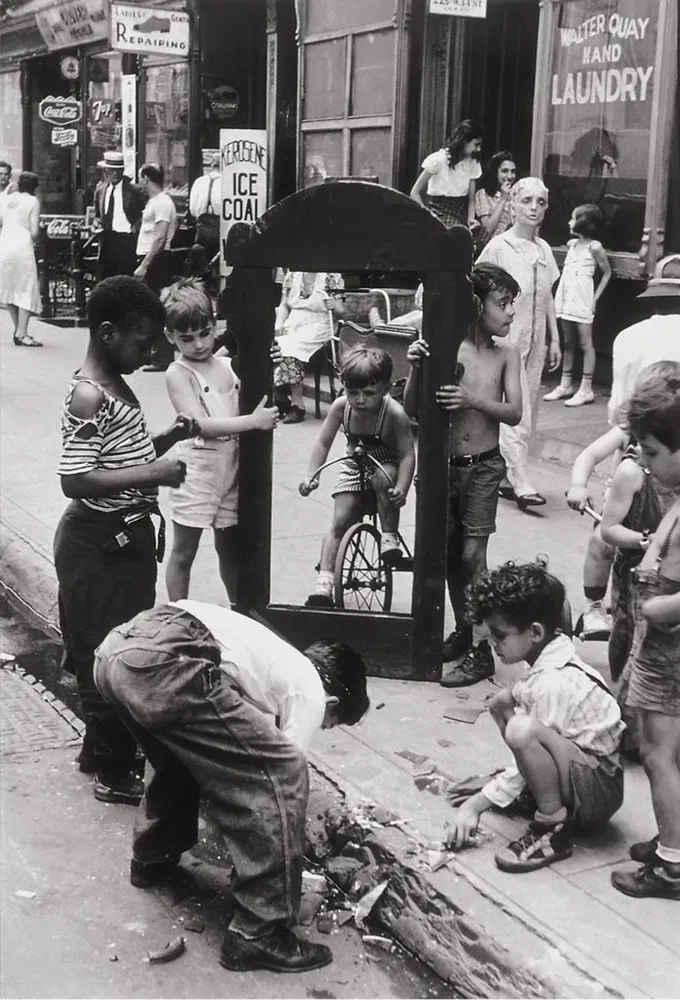
2. Children with Broken Mirror, c. 1940 — Helen Levitt
Helen Levitt (1913–2009) was one of the foremost street photographers of the twentieth century and an early pioneer of colour. She devoted her life to capturing the quiet poetry of everyday life in her native New York, balancing grace, humour, and unflinching honesty. Though she briefly worked in commercial portraiture, her true inspiration came from a chance encounter with Henri Cartier-Bresson in the early 1930s and an exhibition featuring his work alongside that of Walker Evans and Manuel Álvarez Bravo. Armed with her 35 mm Leica, she roamed the neighbourhoods of Manhattan, documenting the city’s stoops, sidewalks, and fleeting gestures in a language shaped by her interests in left-wing politics, avant-garde film, surrealism, and contemporary dance.
Children with Broken Mirror (c. 1940) typifies Levitt’s enduring fascination with the improvisational theatre of the street. Her camera found poetry in the play and performance of children, moments of invention and reflection that mirrored the energy of a city where life unfolded publicly. Here, the broken mirror becomes both prop and metaphor, revealing her uncanny ability to transform ordinary street life into something quietly profound, full of rhythm, imagination, and humanity.
– Read our full profile on Helen Levitt here.
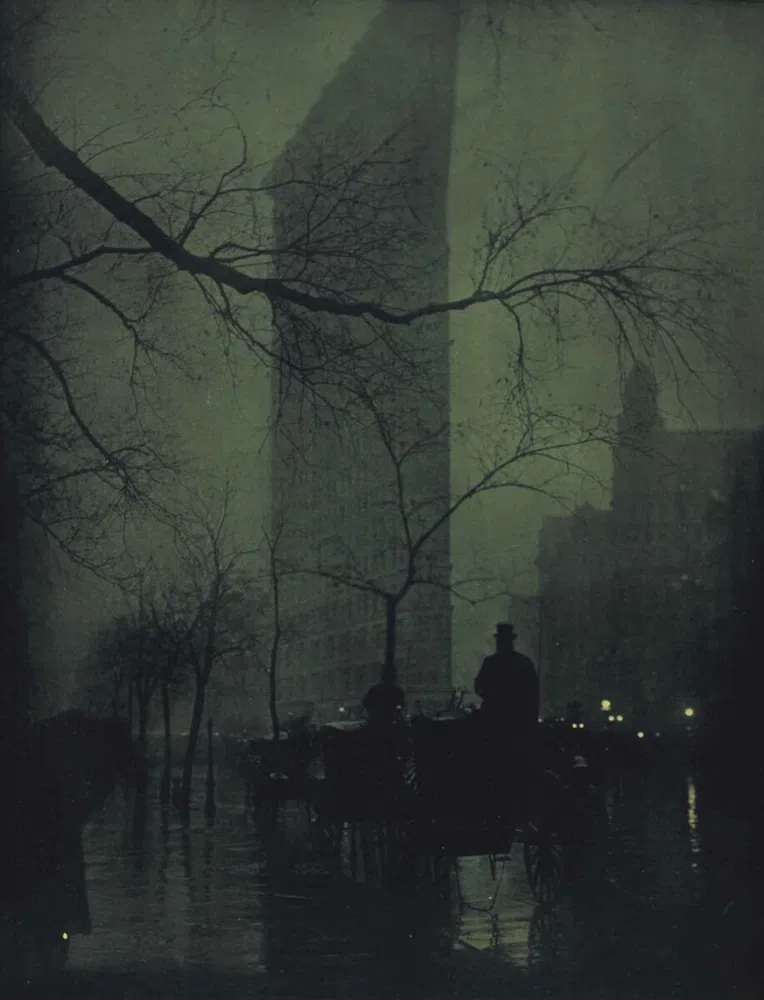
3. The Flatiron, 1904 (printed 1909) – Edward Steichen
Born in Luxembourg, Edward Steichen (1879–1973) is widely regarded as one of the most important figures in photographic history. Alongside Alfred Stieglitz and Clarence H. White, he helped lead the Photo-Secession movement — a pioneering group that championed photography’s recognition as a legitimate art form.
One of the most celebrated images ever made, and the 2nd most valuable photograph ever sold (one of the three prints in existence fetched $11.8 million in 2022), The Flatiron (1904) depicts the newly built landmark rising through a mist-filled Manhattan twilight. Printed five years later, Steichen applied layers of pigment suspended in a light-sensitive solution of gum arabic and potassium bichromate to a platinum print base, creating its rich, painterly hues. The result is a luminous synthesis of photography and painting — a poetic vision of modernity that affirmed, more powerfully than any manifesto, the artistic potential of the photographic image.
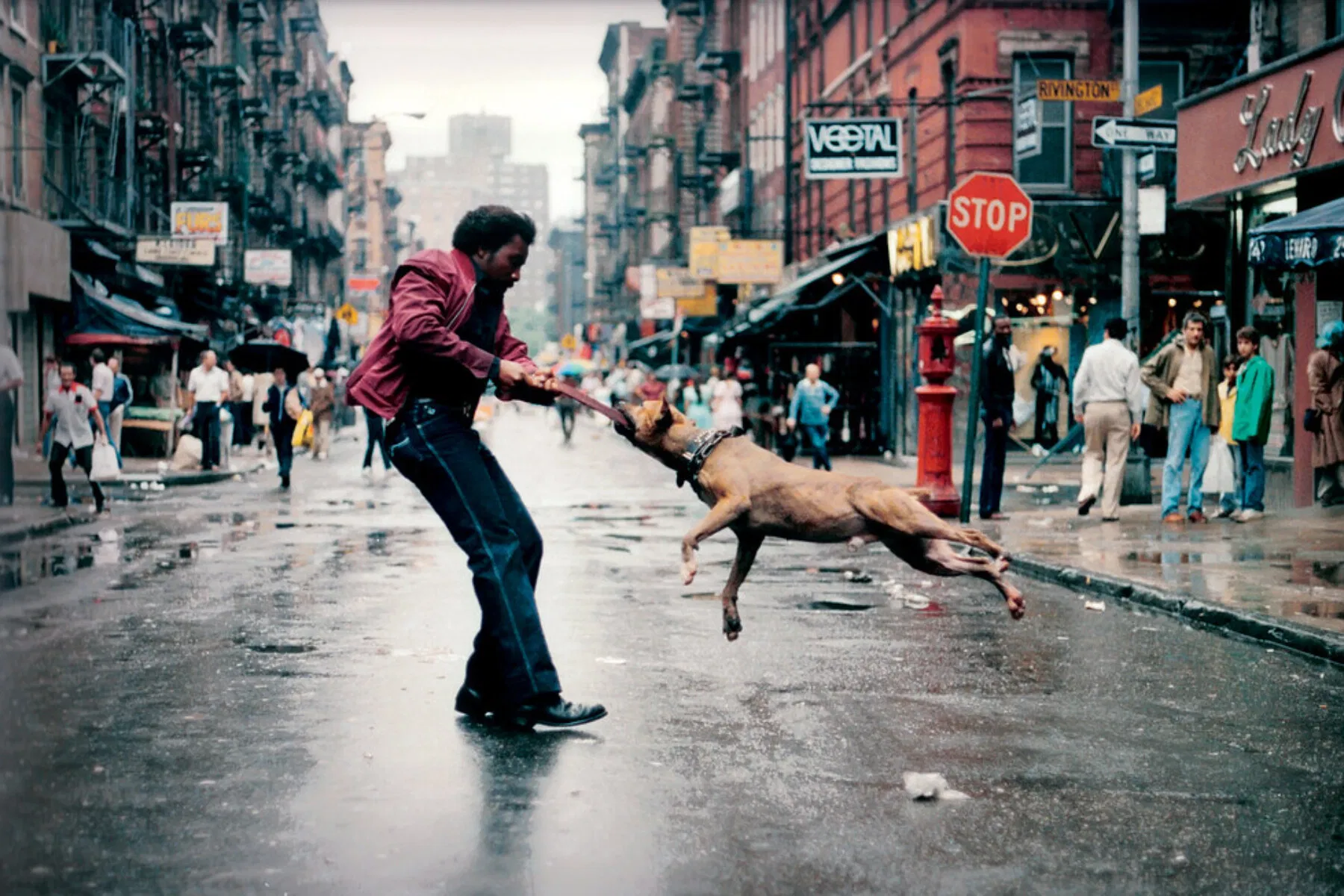
4. Man and Dog, Lower East Side, 1980 – Jamel Shabazz
Brooklyn-born Jamel Shabazz (b. 1960) has dedicated over four decades to capturing the essence of life in his beloved hometown. Inspired by his father’s photography, his teenage camera work began on the streets of New York, and after a stint in the military, he returned to a city in flux—grappling with industrial decline, crime and addiction, yet bursting with the birth-of-hip-hop energy. With a sharp eye and an empathetic heart, he set out to ‘honour and elevate’ his community, rendering its streets, subways and neighbourhoods with a clarity and dignity too often missing in other narratives.
His 1980 image, Man and Dog, Lower East Side, is emblematic of this practice: vivid, direct, and rooted in everyday truth, a fleeting moment is frozen in the city’s chiaroscuro: a man leans into motion, his dog airborne in the jump, the wet pavement reflecting a patch of sky, the tenements of Orchard/Delancey framing them.
– Read our full profile on Jamel Shabazz here.
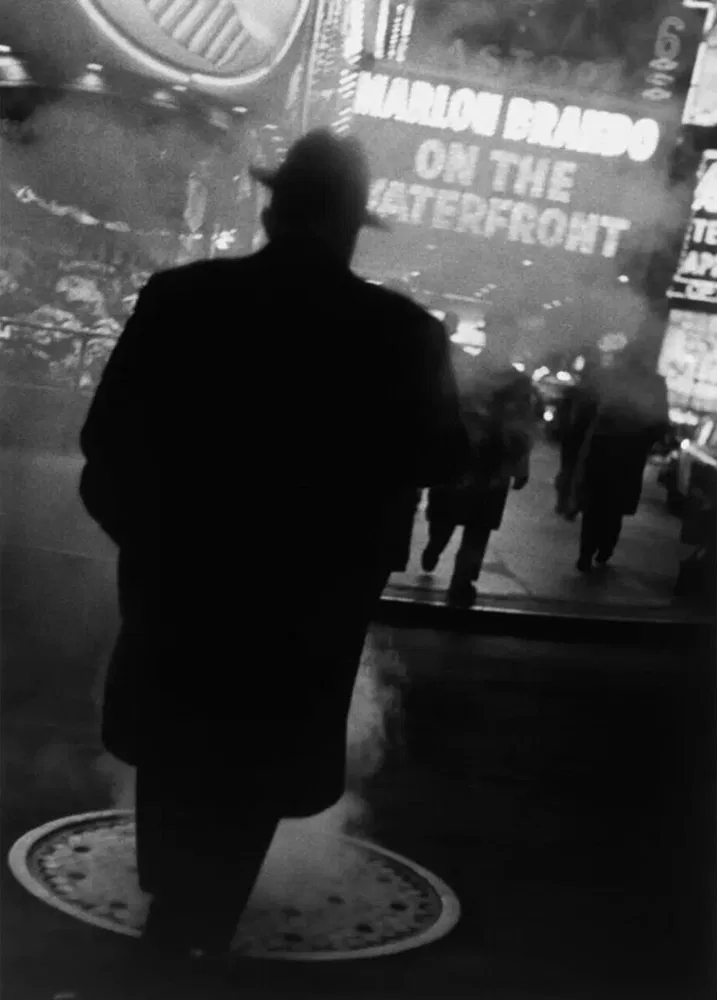
5. “The Great White Way”, Times Square at Night, 1954 — Louis Stettner
Louis Stettner (1922–2016) was a Brooklyn-born photographer whose work blended the clarity of documentary with a deeply humanist sensibility. His life and work moved between New York and Paris, yet it was his native city that remained his deepest source of inspiration. Returning after the war, he wandered its streets with a quiet, perceptive eye, drawn especially to Times Square — a place he saw as both crossroads and stage, where everyday life unfolded with a peculiar mix of glamour and grit.
The Great White Way, Times Square at Night, captures that atmosphere with a distinctly cinematic touch. The title refers to Broadway’s long-standing nickname, earned when its brilliant electric signage made it one of the brightest streets in the world. Yet rather than dwell on spectacle, Stettner turns his attention to the silhouettes moving through the glow: the foreground figure stepping into the frame like an actor entering from the wings, and others drifting in the background, half-formed in the haze. In a district defined by theatre, the scene becomes its own quiet performance, a tribute to one of the most photographed places on earth, recast not in neon bravado but in mood, movement, and shadow.
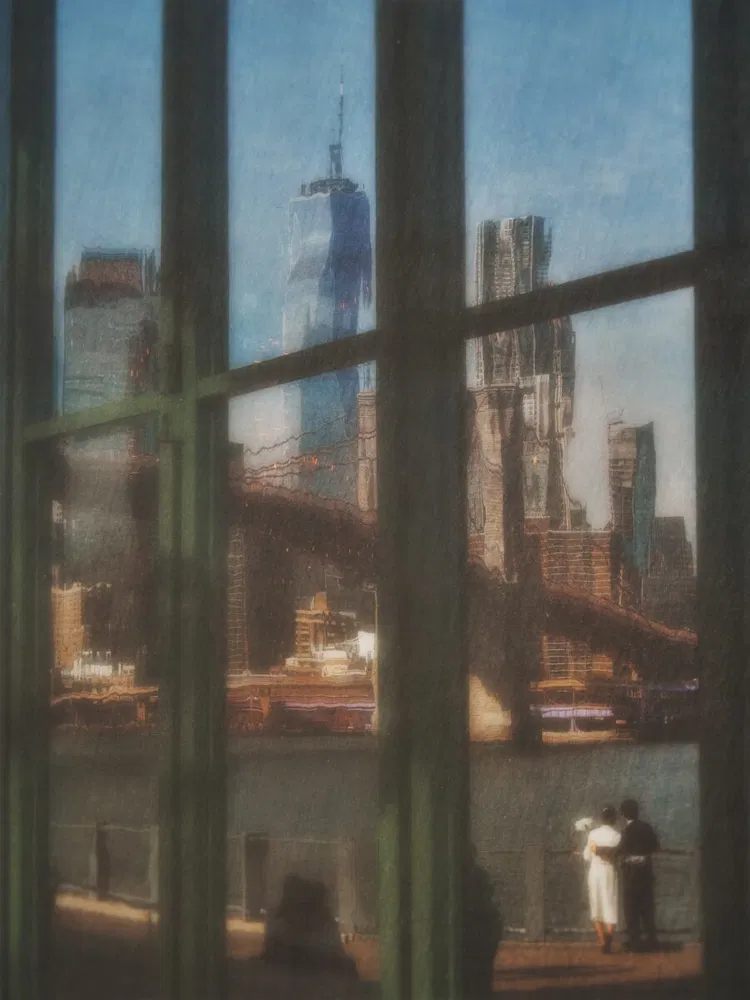
6. “New York I”— Thaddäus Biberauer
Though best known for his ethereal studies of nature, Thaddäus Biberauer brings that same sensitivity to this rare New York photograph. Shot on his second day in the city, the double exposure — framed through corner windows and punctuated by the fleeting appearance of a newlywed couple — carries a quiet, almost painterly quality, its soft overlaps and diffused light recalling the translucence of watercolour.
It’s an unexpected New York image: reflective rather than frenetic, shaped as much by chance as by intention. And while he stands apart from the iconic figures elsewhere in this selection, his inclusion underscores how the city continues to inspire new voices, each finding their own way of distilling its endless, unscripted moments.
– Read our full profile on Thaddäus here.
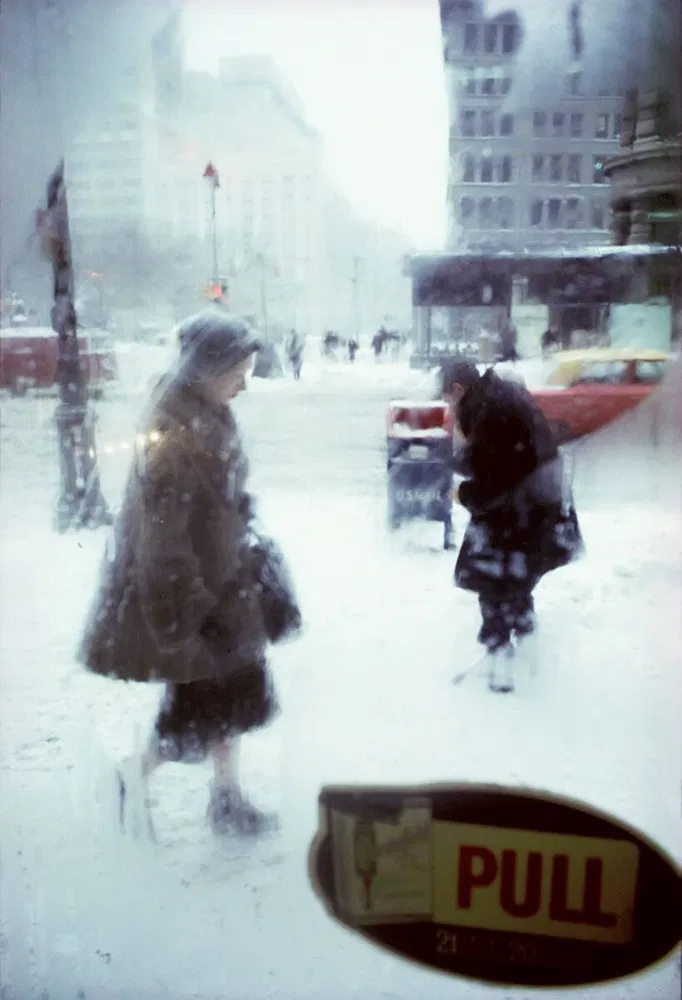
7. Pull C.1960 — Saul Leiter
Saul Leiter (1923–2013) spent nearly his entire life in Manhattan, whose streets provided the quiet stage for his unique, artistic vision. Though often grouped with post-war street photographers, Leiter’s sensibility was altogether different, more artist than documentarian, drawn less to spectacle than to fleeting moments that others might overlook. A lifelong painter, he brought this understanding of tone and form to his photography, becoming one of the early pioneers of color, which he used not for description but for expression: to evoke mood and texture rather than record fact.
This image, though not among his best-known, captures this sensibility with characteristic subtlety. Shot through a window blurred by condensation and cold, two figures cross a snow-covered street as the city dissolves into mist and motion. What might have been mundane becomes quietly transcendent, an intimate moment suspended within the larger rhythm of New York, rendered with the sensitivity, color, and eye for composition that defined Leiter’s lifelong dialogue with his city.
– Read our full profile on Saul Leiter here.
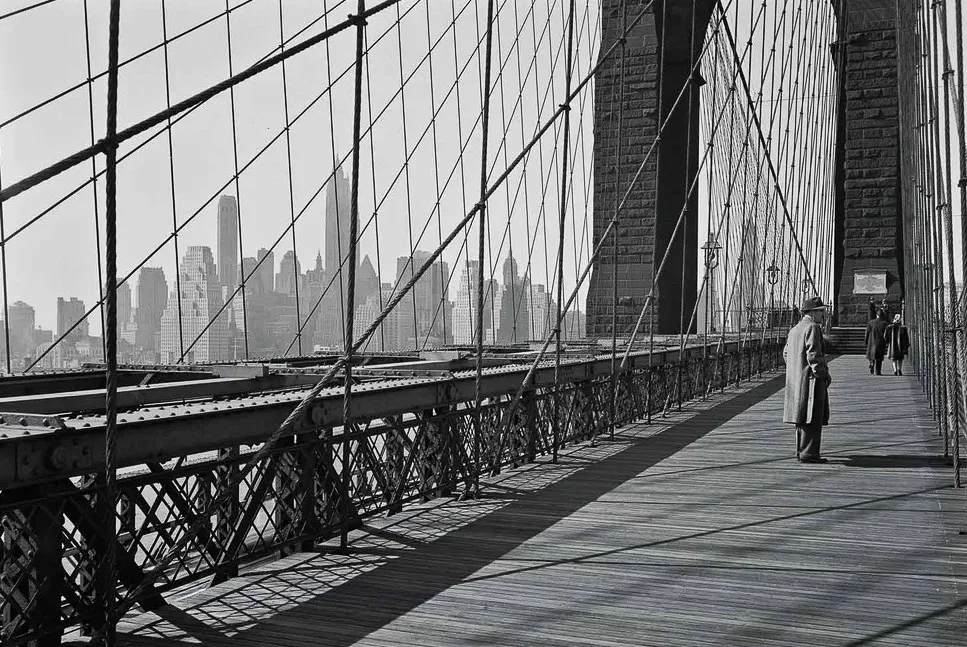
8. Brooklyn Bridge, New York, 1946 – Todd Webb
Often described as one of the most sensitive observers of post-war urban life, Todd Webb (1905–2000) produced one of the defining photographic records of New York during the year he spent walking the city in 1946. Working with a large-format camera and an instinct for calm, unhurried observation, he created images that revealed the everyday poetry of a metropolis emerging from wartime austerity.
Webb produced several now-iconic views of the Brooklyn Bridge, yet this one, is a more intimate and lesser-known. He later recalled that he made the picture on his very first walk across the bridge, with only enough film for six exposures. When he returned the next day, better prepared, he found officials enforcing a photography ban, making this fleeting encounter the only record he captured. The result is a quietly human image: a lone figure pausing on the wooden walkway, the lattice of cables guiding the eye toward a soft Manhattan skyline. It is the bridge, not as a monument, but as a place briefly inhabited, a moment of stillness preserved by chance.
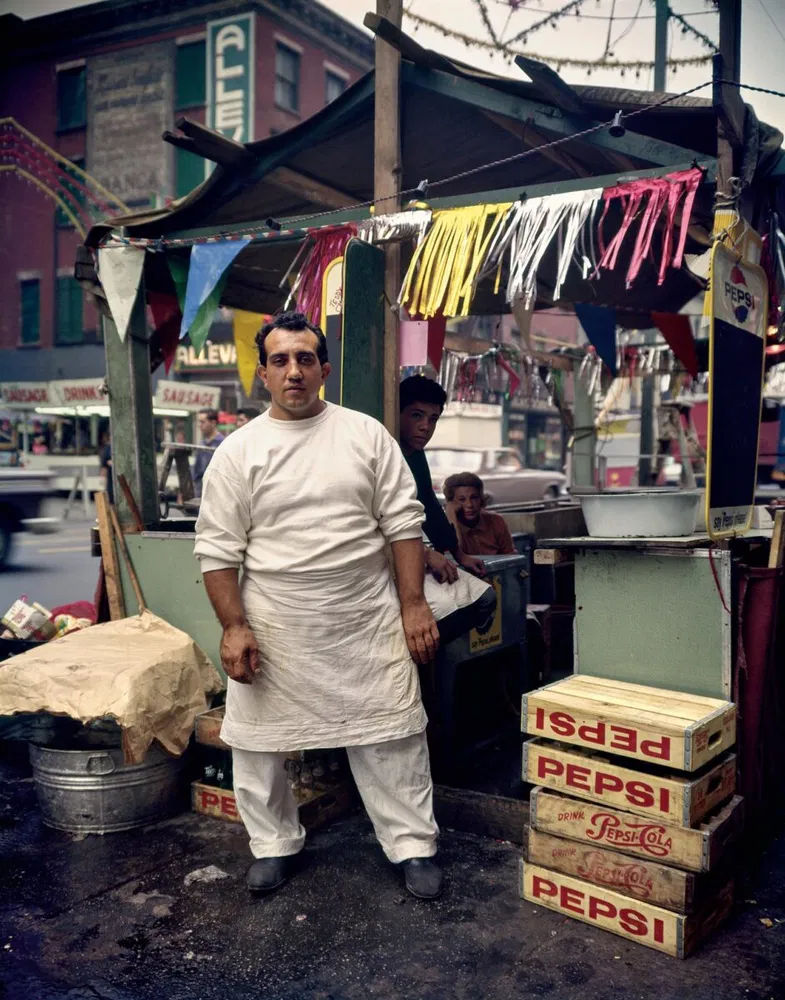
9. Little Italy, 1965 — Evelyn Hofer
Few photographers have captured the essence of their subjects quite like Evelyn Hofer (1922–2009), the German-born artist whose quietly powerful portraits and cityscapes reveal a lifelong fascination with people and place. Though she photographed across the globe — illustrating books on Florence, Paris, and Dublin — it is her depiction of New York, where she settled in the mid-1940s, for which she is perhaps best known.
With a painter’s eye for colour and composition, Hofer portrayed her adopted city with grace and precision, often photographing her subjects within their own environments using a tripod-mounted, medium-format camera — a deliberate, meditative approach that contrasted sharply with the handheld spontaneity of her contemporaries. The resulting images possess a remarkable stillness and dignity, balancing documentary realism with quiet artistry. Little Italy, New York, 1965 exemplifies this vision: a tender group portrait, perhaps spanning three generations, it conveys both the individuality of its sitters and the enduring character of a neighbourhood that, like Hofer’s work itself, seems suspended in time.
– Read our full profile on Evelyn Hofer here.

10. Central Park South Silhouette, 1955 – Ruth Orkin
Ruth Orkin (1921–1985) was an award-winning photojournalist and filmmaker whose deeply human images captured the poetry of everyday life. Though she gained international acclaim for her photographs made while travelling — most famously in Italy — New York remained her true home and greatest muse. In 1955, she moved into an apartment overlooking Central Park, where she began photographing the city from her window, later published in her celebrated book A World Through My Window (1978).
Central Park South Silhouette (1955) exemplifies this period: the skyline rises like a mirage beyond the bare winter trees, figures gather quietly on benches, their outlines etched against the pale light. It’s a portrait of stillness amid movement, of solitude and connection, the city seen with both affection and restraint. Orkin once said, “If my photographs make the viewer feel what I did when I first took them, then I’ve accomplished my purpose.” In this image, she does exactly that.
– Read our full profile on Ruth Orkin here.
All images © their respective owners