

From ancient monuments to moments of revolution, the photographic history of Egypt unfolds across millennia, where myth, faith, and daily life exist in constant dialogue.
Rooted in one of the world’s oldest civilizations and shaped by centuries of conquest, belief, and resistance, Egypt has long occupied a unique position in the global imagination. Its image has been endlessly reproduced, from the monumental to the intimate, yet the most enduring photographs move beyond the familiar icons to reveal a country defined not only by its past, but by its people, contradictions, and continuities.
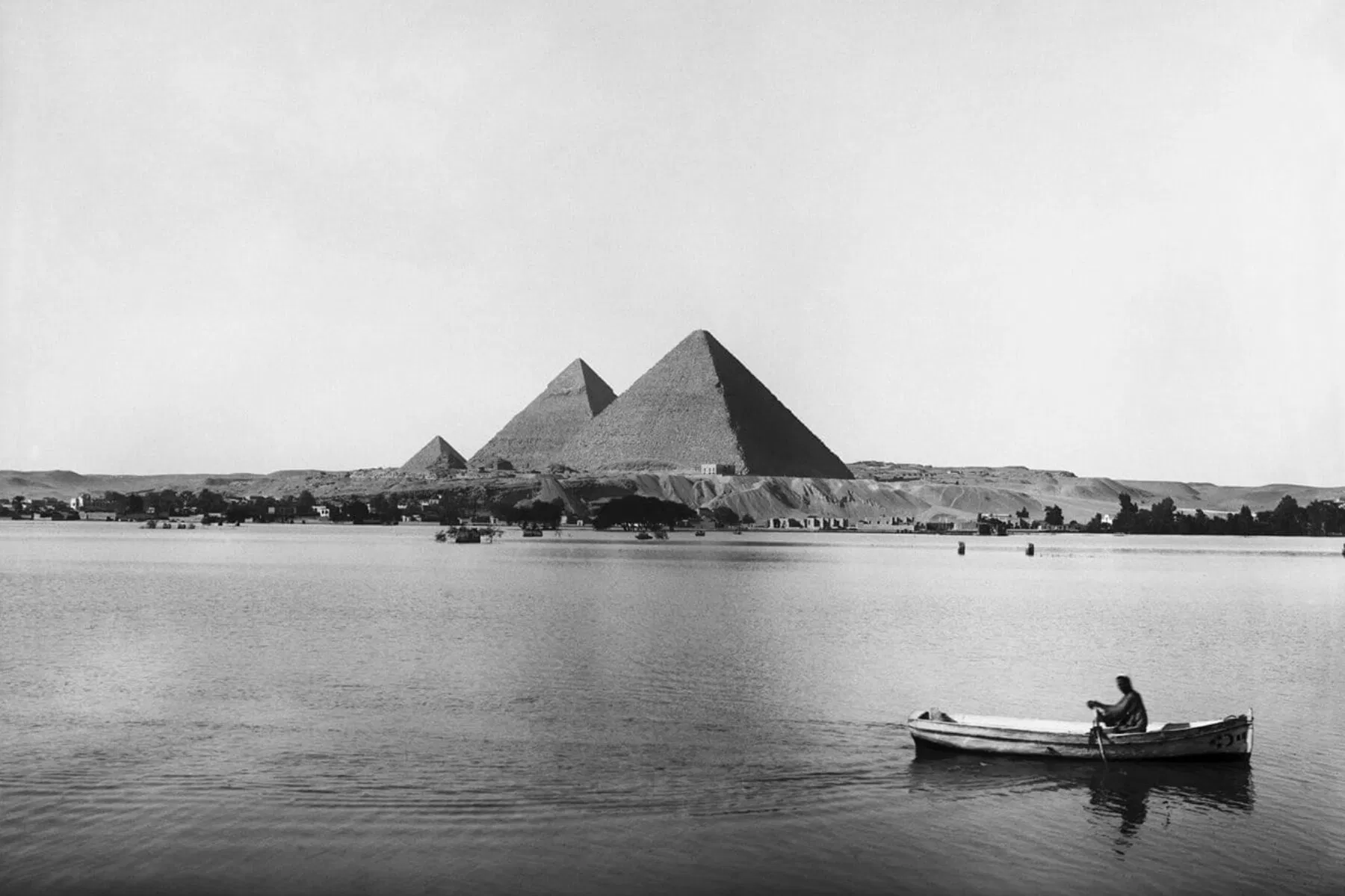
1. Boatman crossing inundated fields just east of the Giza Pyramid Complex, October 1927 – Mohammedani Ibrahim
At the height of the annual Nile inundation in October 1927, Egyptian photographer Mohammedani Ibrahim captured this striking image of a lone boatman wading through floodwaters just east of the Giza Pyramid Complex: waters that, for millennia, governed life along the river’s edge. Born in the Nile town of Qift in the late 19th century, Ibrahim became one of Egypt’s most accomplished archaeological photographers, documenting both the rhythms of everyday life and the painstaking excavations around Giza under archaeologist George Reisner.
His work is marked by a precise command of light and composition, allowing human presence to emerge quietly yet decisively within monumental settings. Set against stones that have endured for thousands of years, the photograph also records a lost natural order: the annual flood that sustained Egypt for centuries, before the Aswan High Dam permanently reshaped the Nile’s ancient cycle in the 1960s.
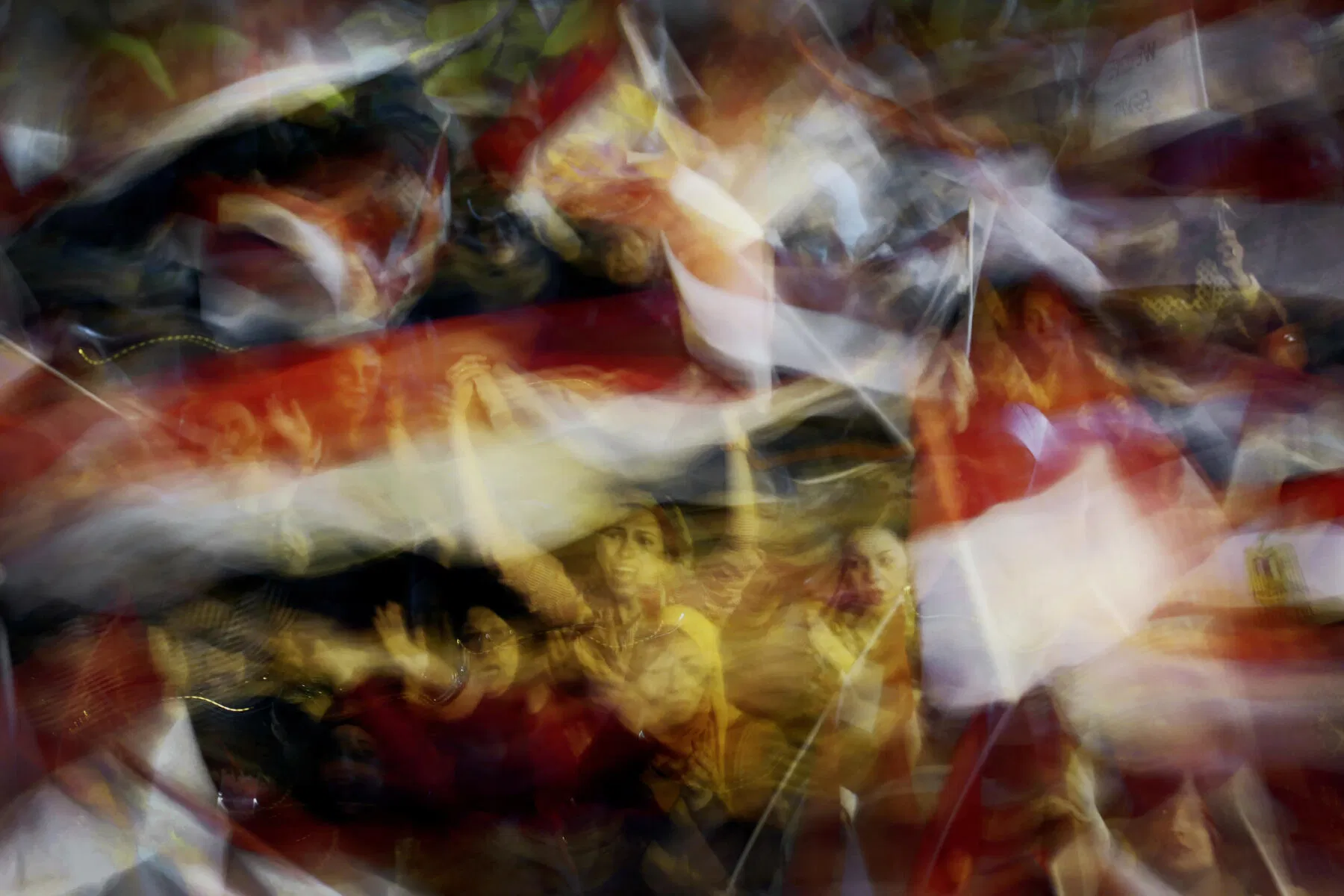
2. “Women of Tahrir”, Tahrir Square, Cairo, June 28, 2013. From the series “In the Shadow of the Pyramids” – Laura El-Tantawy
British-Egyptian photographer Laura El-Tantawy’s In the Shadow of the Pyramids stands as one of the most vital photographic testimonies of modern Egypt, tracing the years before, during, and after the 2011 revolution through a lens shaped by both intimacy and rupture. Moving between insider and observer, El-Tantawy documents a nation emerging from decades of repression, her images charged with uncertainty, anger, hope, and loss, echoing the emotional volatility of a society in upheaval.
In Women of Tahrir, the individual dissolves into the collective. Faces surface and recede through motion and colour, submerged within a tide of red, white, and black, as flags overwhelm the frame and bodies blur into one another. The image resists clarity, mirroring the disorientation of revolution itself—its noise, momentum, and emotional force. Less a document than a visceral impression, it captures history not as a fixed moment, but as something unstable and unfinished, carried forward by those who stood their ground within it.
– Read our review of the book here.
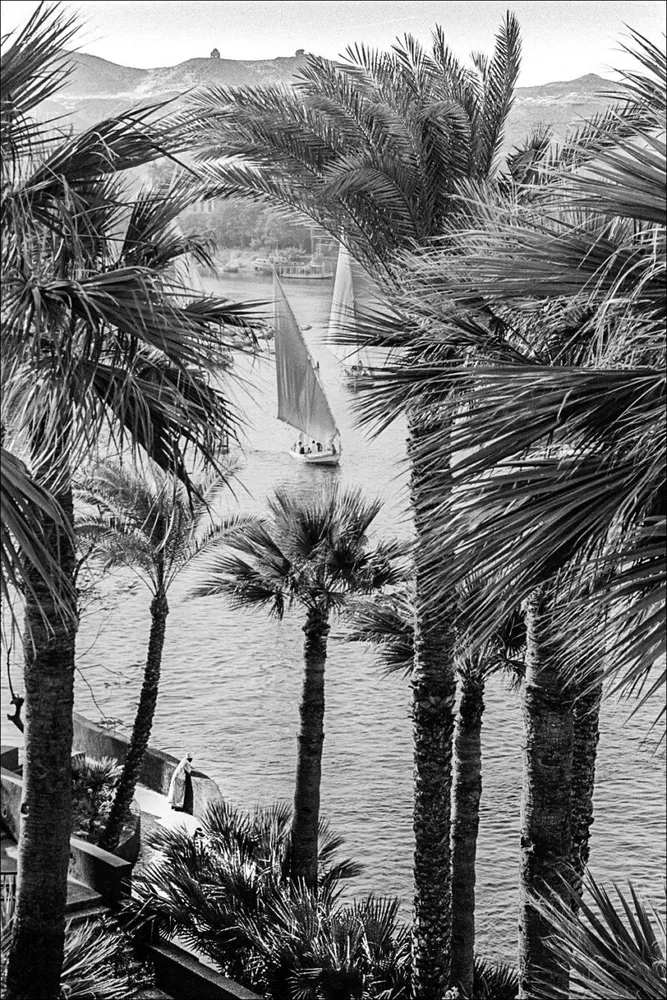
3. Aswan, Egypt – Xavier Roy
Set along the southern stretch of the Nile, Aswan has long been a threshold city, where ancient Nubian culture, Pharaonic history, and the rhythms of the river converge. For millennia, it served as a vital trading post and gateway between Egypt and sub-Saharan Africa, its identity shaped as much by water as by stone. Even today, Aswan retains a slower, more measured pace, defined by the Nile’s gentle curves, palm-lined banks, and the enduring presence of traditional river life.
In this 2004 photograph, Xavier Roy beautifully captures the Nile as both landscape and lifeline. A solitary felucca glides through the centre of the frame, its sail catching the light much as it has for centuries. Framed by dense palms and backed by the stark hills of Upper Egypt, the scene unfolds in layered stillness, shadow and reflection, movement and rest. Rendered in black and white, the image emphasises texture and form over colour, allowing the river’s quiet permanence to emerge, and has a timeless quality, a vision of Aswan not as spectacle, but as continuity: a place where history, nature, and daily life remain inseparably entwined.
– Read our profile on Xavier here.
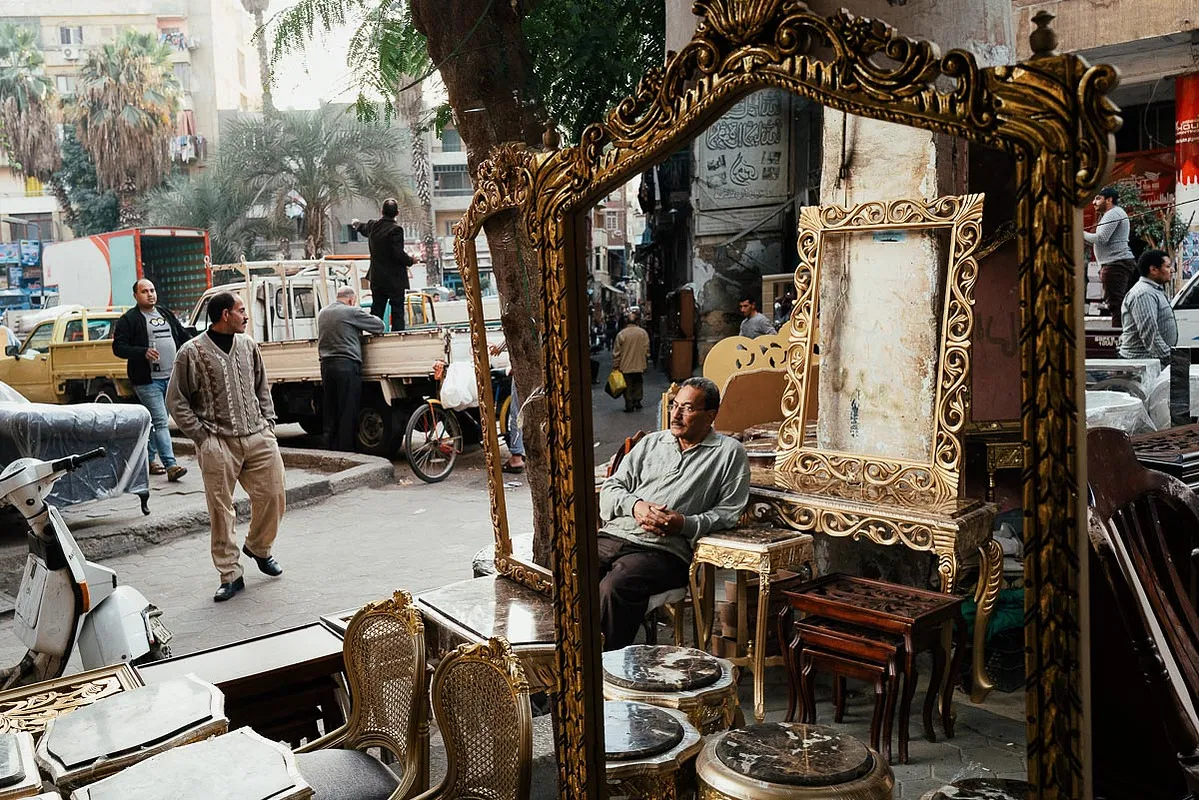
4. From the series “Cairo: a beautiful thing is never perfect” – Jonathan Jasberg
Jonathan Jasberg, a self-described vagabond and one of today’s most accomplished street photographers, has long traced the rhythms of Cairo, capturing the city’s “beautiful mess” with an eye attuned to spontaneity, layering, and the decisive moment. His work transforms fleeting, overlooked fragments of daily life into something cinematic, charged with tension and grace. Mirrored Worlds embodies the contradictions that define Cairo: stillness amid chaos, reflection amid motion, beauty within imperfection. Through his lens, the city becomes a layered, living composition, one where moments accumulate, overlap, and reveal the subtle poetry of the everyday.
– Read our profile on Jonathan here.
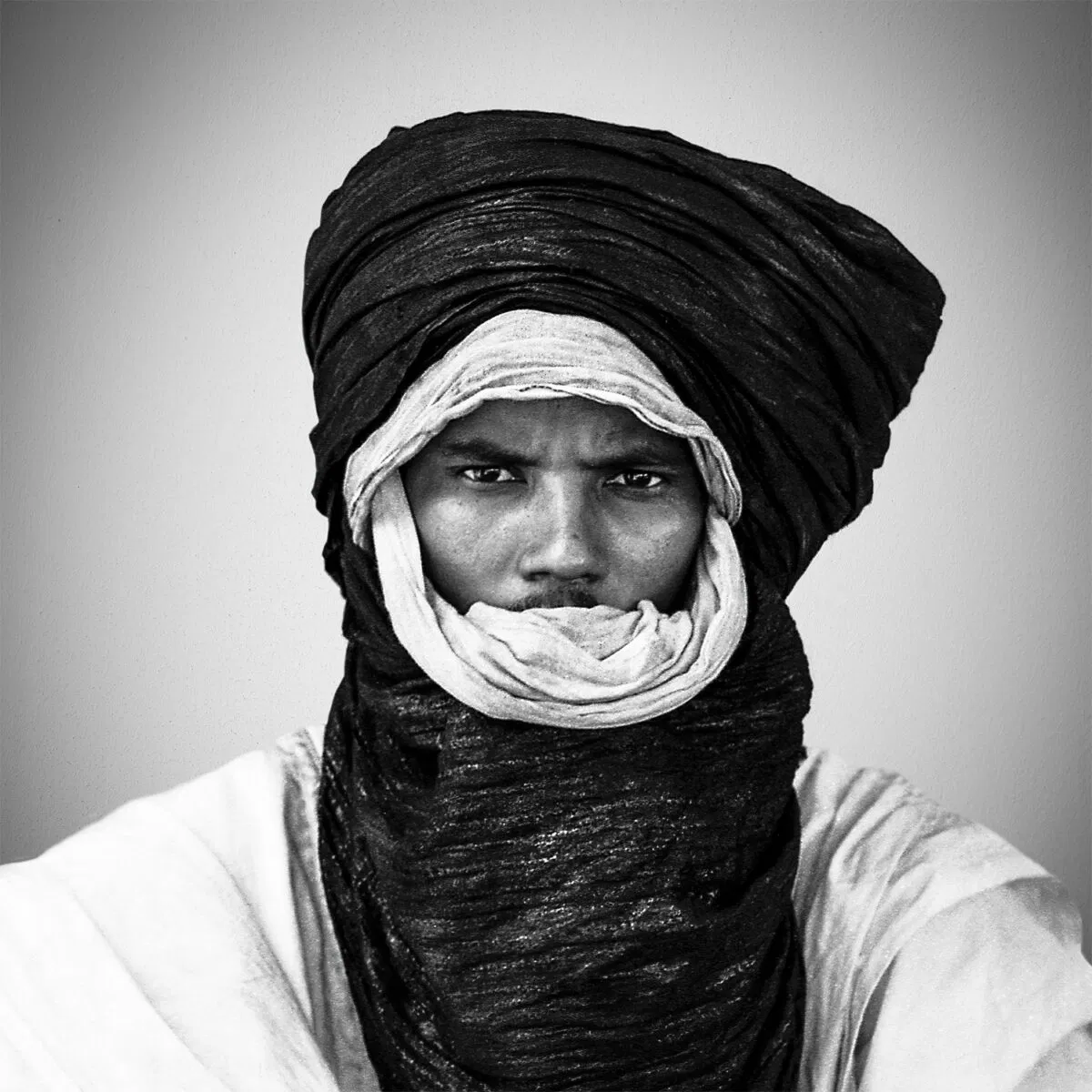
5. “Street portrait”, Cairo – Geffrard Bourke
Even within Egypt’s most modern metropolis, traces of ancient rhythms and enduring forms of dress slip into the everyday. In this striking black-and-white moment, Geffrard Bourke’s subject meets the camera with an intense, steady gaze, their wrapped cloth echoing both function and history. Headscarves and face coverings like this—rooted in the broader traditions of North African and Arab dress that protect against sun, wind, and sand—are practical yet deeply familiar across the region’s cities and deserts alike.
The monochrome treatment strips the scene to texture and presence, allowing the layered fabric and the subject’s eyes to speak. Isolated from the bustle of the street, the figure becomes both individual and emblematic: a quiet testament to the ways traditional forms of dress continue to live within Cairo’s urban pulse, bridging past and present without spectacle.
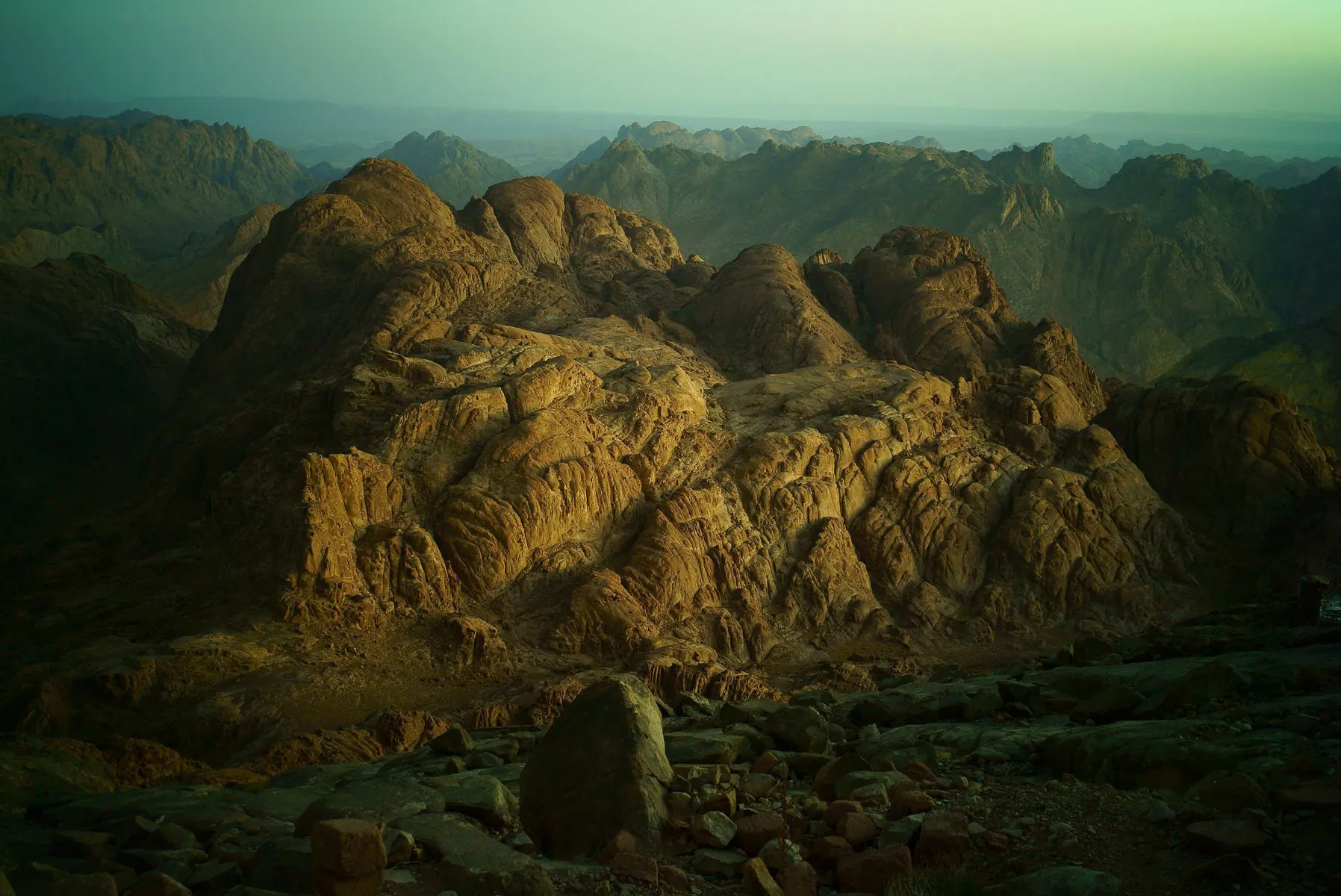
6. “The Golden Summer” – Sinaï, Egypt 2018. View from Moussa Mountain near St Katherin Monastery – Brieuc Le Meur
Rising from the arid landscape of Egypt’s Sinai Peninsula, Mount Sinai occupies a singular place in the spiritual imagination of the world. Revered across Judaism, Christianity, and Islam, it is believed by many to be the site where Moses received the Ten Commandments, a moment that shaped the moral and theological foundations of the Abrahamic religions. Long before borders, empires, or modern nations, this terrain functioned as sacred ground, where revelation and law were thought to intersect. Photographed here by Brieuc Le Meur, in the low light of dawn or dusk, the mountain’s ancient, eroded forms appear to resist time itself, reinforcing Sinai’s enduring role not merely as geography, but as a place of belief, pilgrimage, and profound historical gravity.
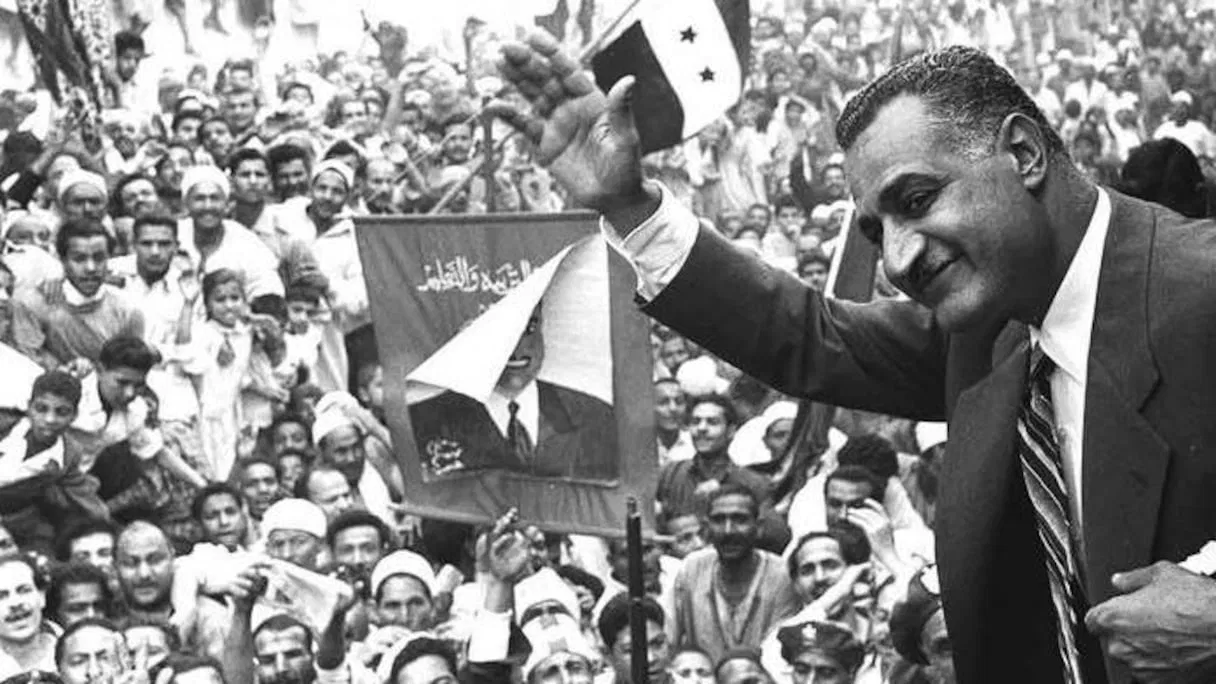
7. Gamal Abdel Nasser, Mansoura, 1960 – Unknown
By 1960, Gamal Abdel Nasser stood at the apex of his influence, embodying a moment when Egypt imagined itself not only sovereign but central to the destiny of the Arab world. In the wake of the Suez Crisis, his defiance of former colonial powers had transformed him into a symbol of dignity, resistance, and collective aspiration. Nasserism was not merely a political doctrine, but a shared emotional current, felt most powerfully in gatherings like this—where leadership and popular will appeared to converge.
Captured during the brief life of the United Arab Republic, the image carries the optimism of a unified Arab future, a dream that would soon fracture but never fully disappear. Mansoura, a city long associated with resistance to foreign rule, becomes here a stage where past and present briefly align. With the benefit of hindsight, the photograph reads as both proclamation and premonition: a record of mass belief at its height, suspended just before the ideals it carried began to unravel.
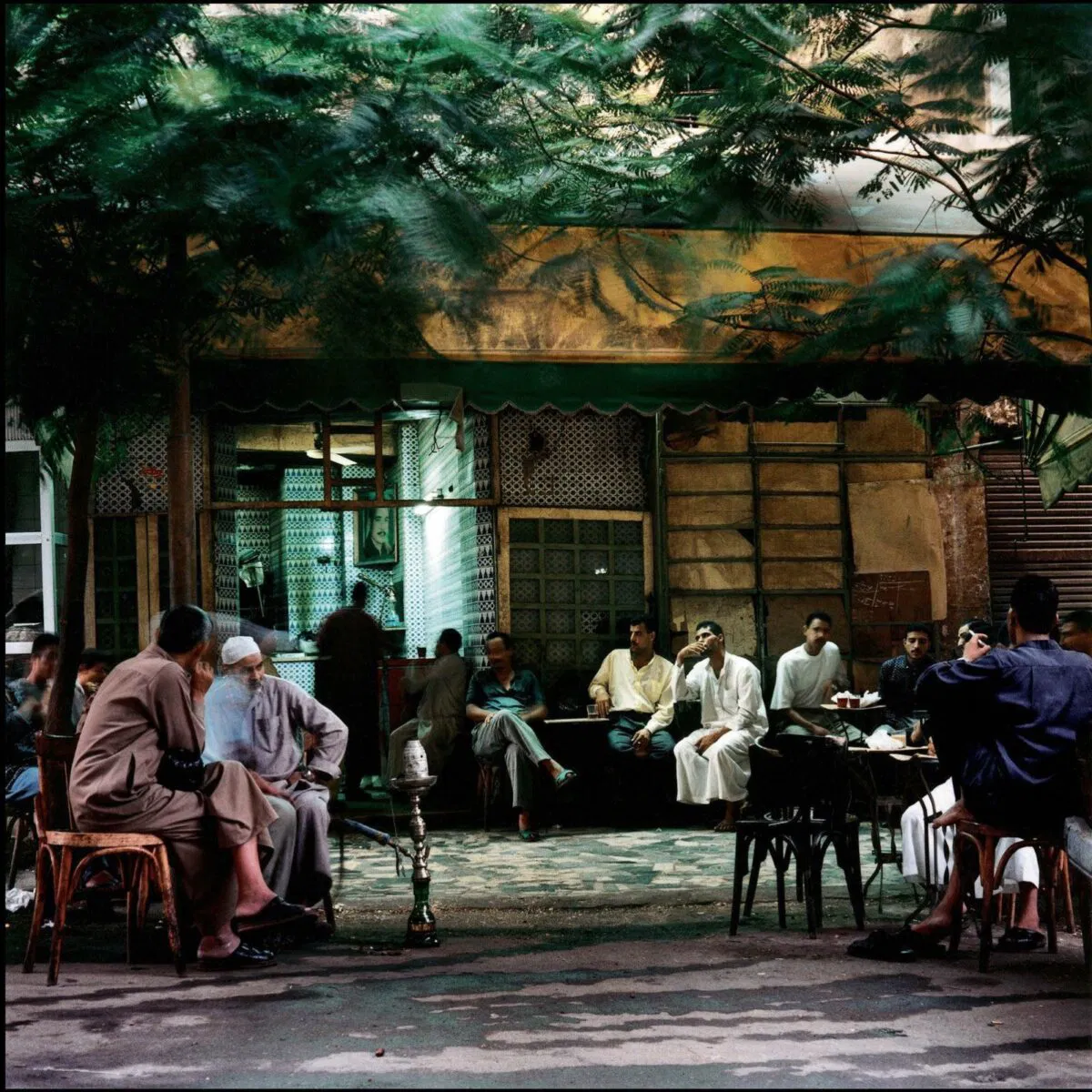
8. Coffee Shop in Bab Zuwella at Dawn, Cairo, 1994 – Denis Dailleux
Denis Dailleux’s relationship with Egypt spans decades, beginning with a visit in 1992 to join his Egyptian lover in Cairo. Captivated by the country’s rich history, vibrant streets, and the warmth of its people, he returned repeatedly, eventually living there and documenting life with an intimate, painterly eye. His photography reveals a deep respect for human connection, capturing moments of everyday life with tenderness, color, and a masterful sense of light and form.
In this 1994 image, Dailleux finds poetry in the quiet rhythms of social life. A group of men gathers at a traditional café in Bab Zuwella, framed by dappled morning light and overhanging branches. Shisha pipes and tea glasses punctuate the scene, while the glowing tiled interior draws the eye, creating a contrast of warm tones and shadows. The photograph’s layered composition and natural framing place the viewer in the midst of this intimate, urban moment, both ordinary and timeless, a testament to the enduring human pulse of Cairo.
– Read our editorial on Denis Dailleux’s relationship with Egypt here.
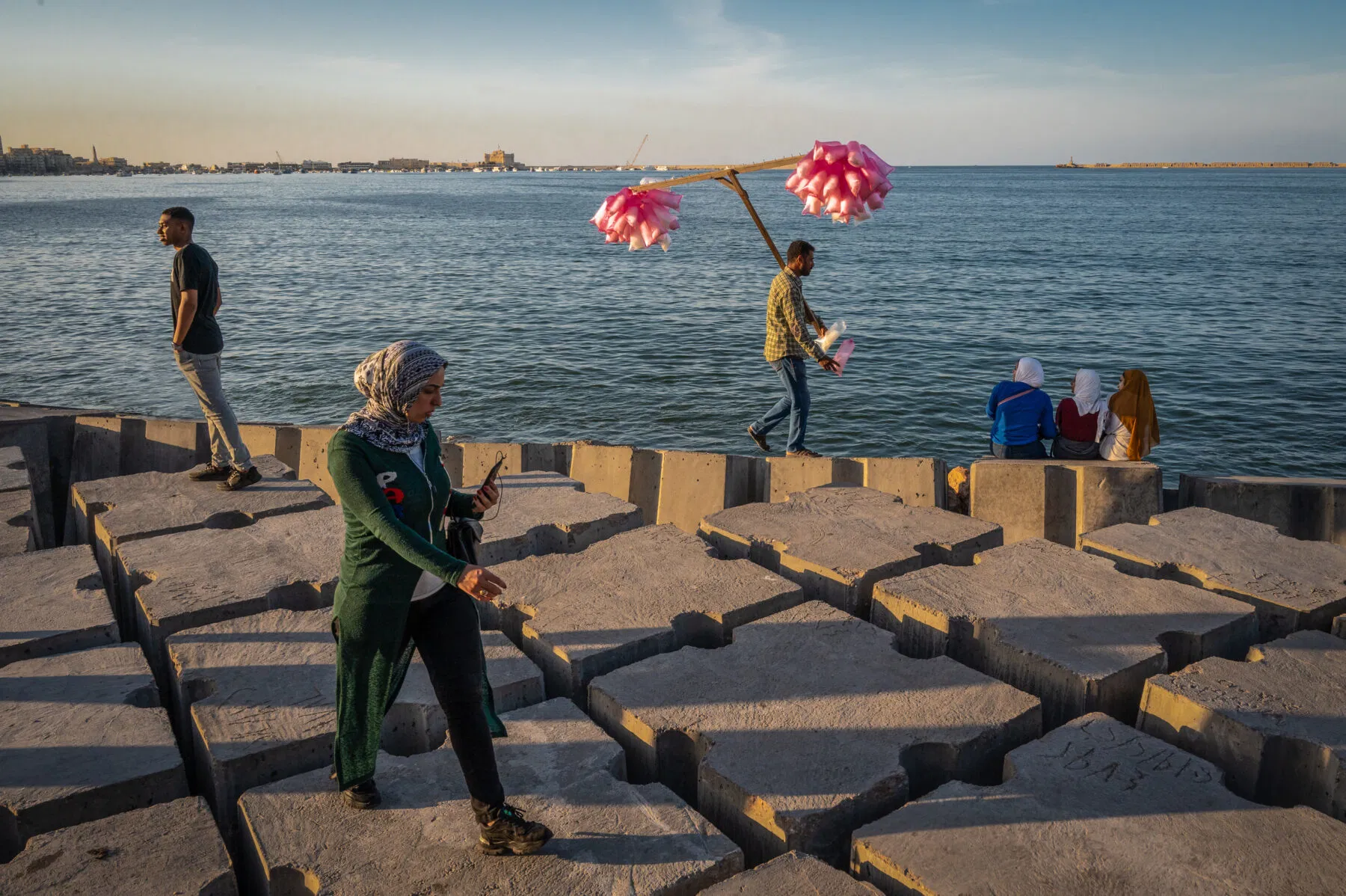
9. Alexandria, 2 November 2021 – David Keith Brown
Along the waterfront of Alexandria, David Keith Brown captures the easy rhythm of a late afternoon by the sea. Warm light drifts across the concrete blocks, softening their weight and lending the scene a gentle, almost cinematic calm. Figures pass through the frame, each in their own world, their movements incidental yet essential, grounding the photograph in lived experience rather than spectacle. It is a quiet portrait of Alexandria as it is felt rather than announced, a city where public space, light, and daily routine merge into a shared, unselfconscious moment.
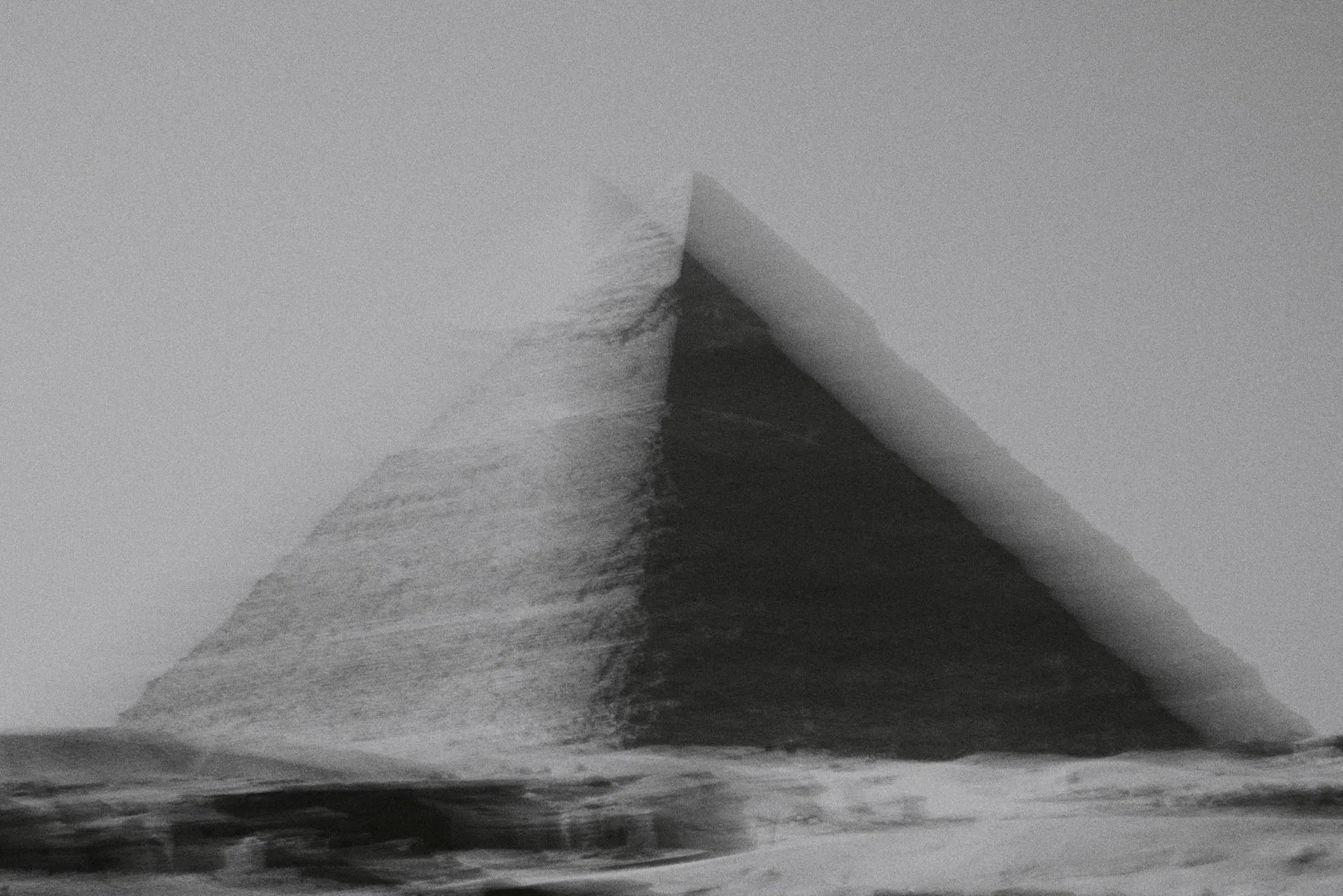
10. Pyramid of Khafre, Giza Necropolis – Christopher Baker
Few structures on earth are as instantly recognisable as the pyramids of Giza, ubiquitous in photographs and collective imagination alike. Yet here, the familiar is rendered strange once more. By isolating the Pyramid of Khafre from its more frequently depicted neighbours, Christopher Baker allows the monument to stand alone, austere and monumental. It is a deliberate choice: of the three pyramids, Khafre’s is the only one to retain traces of its original limestone casing at the summit, a detail subtly accentuated as light grazes its apex.
Rendered in black and white, the image strips away spectacle and scale, focusing instead on form, texture, and atmosphere. A soft blurring at the base and shimmering edges—suggestive of intentional camera movement or heat-hazed long exposure—imbue the structure with a dreamlike instability. Rather than documenting a landmark, Baker transforms the pyramid into an apparition: ancient, weightless, and suspended between presence and memory.
All images © their respective owners