

GOST Books presents MAPALAKATA by Robin Bernstein, a deeply absorbing exploration of a historically, geologically, and geographically complex region of Southern Africa.
South African photographer Robin Bernstein has spent much of his career photographing the places and communities around him, often looking at the traces that history, industry, and everyday life leave on the landscape. His work has a strong sense of place, but there is also something quietly observational about it, allowing details and encounters to build a picture of a location over time.

The title, MAPALAKATA — meaning “visitors” — comes from oral histories and was originally used to describe Eastern traders who travelled through Southern Africa long before European colonisation. It feels particularly fitting here, referring to the many different groups who have passed through, settled in, and taken from this landscape over generations.
The work is situated in South Africa’s Mpumalanga province, along the dramatic escarpment bordering Mozambique and Eswatini, where lush cliffs drop abruptly into hot, red lowlands, creating a landscape shaped by shifting borders, migration, conflict, and industry. Once the edge of the South African frontier, the region has inspired centuries of folklore and later became central to the country’s modern gold rush.

Today, the region remains marked by the industries and histories that have passed through it. Foreign timber plantations cover the high ground, mills churn out steam as pine is processed into paper, and deep in the valleys, gold mines continue a century-long process of steel against rock.
Scattered throughout the landscape are traces of successive eras: the remnants of pre-colonial societies, alongside the descendants of horses abandoned during past wars and failed gold rushes. They become small reminders of the people, industries, and ambitions that have come and gone.


Bernstein moves between the physical traces of the past and the people who inhabit the landscape today, bringing together environmental portraiture, stark industrial details, and atmospheric landscapes.
Across the work, the region emerges as a place where different histories overlap: the remains of those who came before sitting alongside the industries, communities, and scars left by those who followed. In this sense, the landscape becomes a kind of living record, continually shaped and rewritten by the people who pass through it.

Visually, Bernstein builds a subtle, tension-filled rhythm across the sequence. Generous white margins give each image room to breathe, with many photographs placed alone on the right-hand page of a spread, leaving the opposite page completely white.
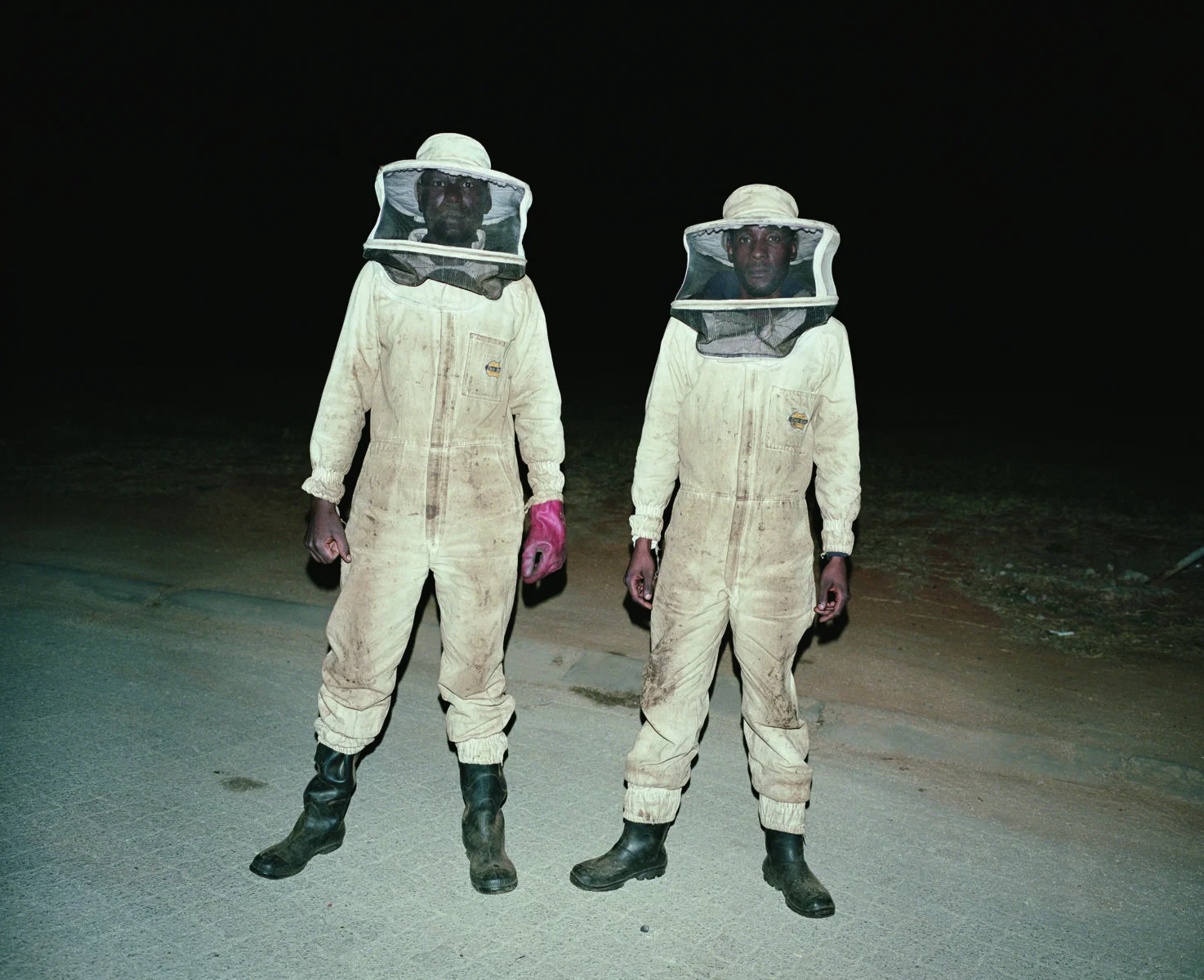
The result is a considered pace that lets each image sit before the sequence moves on. In one sequence, two figures dressed in white beekeeping suits stand almost like spectres against the darkness of night. In another, a pregnant woman wrapped in dramatic white fabric stands poised against a harsh, sun-baked rock face.

Elsewhere, the photographs become more intimate. A young girl is framed in the warm glow of an open refrigerator, while other domestic scenes offer brief glimpses into everyday life.
These quieter moments are set against vast, smoke-hazed views of the Mpumalanga hills and deep, overgrown fissures cut into the earth. The contrast gives the book much of its character, moving constantly between the personal and the vast, the familiar and the unsettling.


There is also something slightly strange and dreamlike about the way Bernstein photographs the region. Horses appear against open landscapes, industrial structures emerge through smoke and vegetation, and people are often placed within environments that seem to dwarf them. Yet the work never feels detached from the reality of the place. The photographs remain grounded in the people who live there and in the physical landscape they have inherited.

It is an impressive and deeply nuanced debut. Beautifully presented by GOST Books, MAPALAKATA brings together the human, industrial, and ecological histories bound to this part of South Africa, while leaving space for the contradictions within them.
What emerges is a portrait of a landscape that has been shaped again and again by those passing through it, and of the traces they inevitably leave behind.
“The name Mapalakata once meant traders. Men who came inland with cloth and beads, their packs heavy with salt and brass. They followed the flow of rivers, trading what they could carry for gold and hides and grain. The world they moved through was a web of bargains. Even now the region works with the same logic.” – Desmond Latham (Excerpt from MAPALAKATA)
All Images © Robin Bernstein
MAPALAKATA is published by GOST and is available via their website.